
Skip Bin Booking Online: What Customers Expect in 2026
Customers compare your booking flow to Uber and Amazon, not to other skip bin sites. Here is what a modern online hire experience looks like.
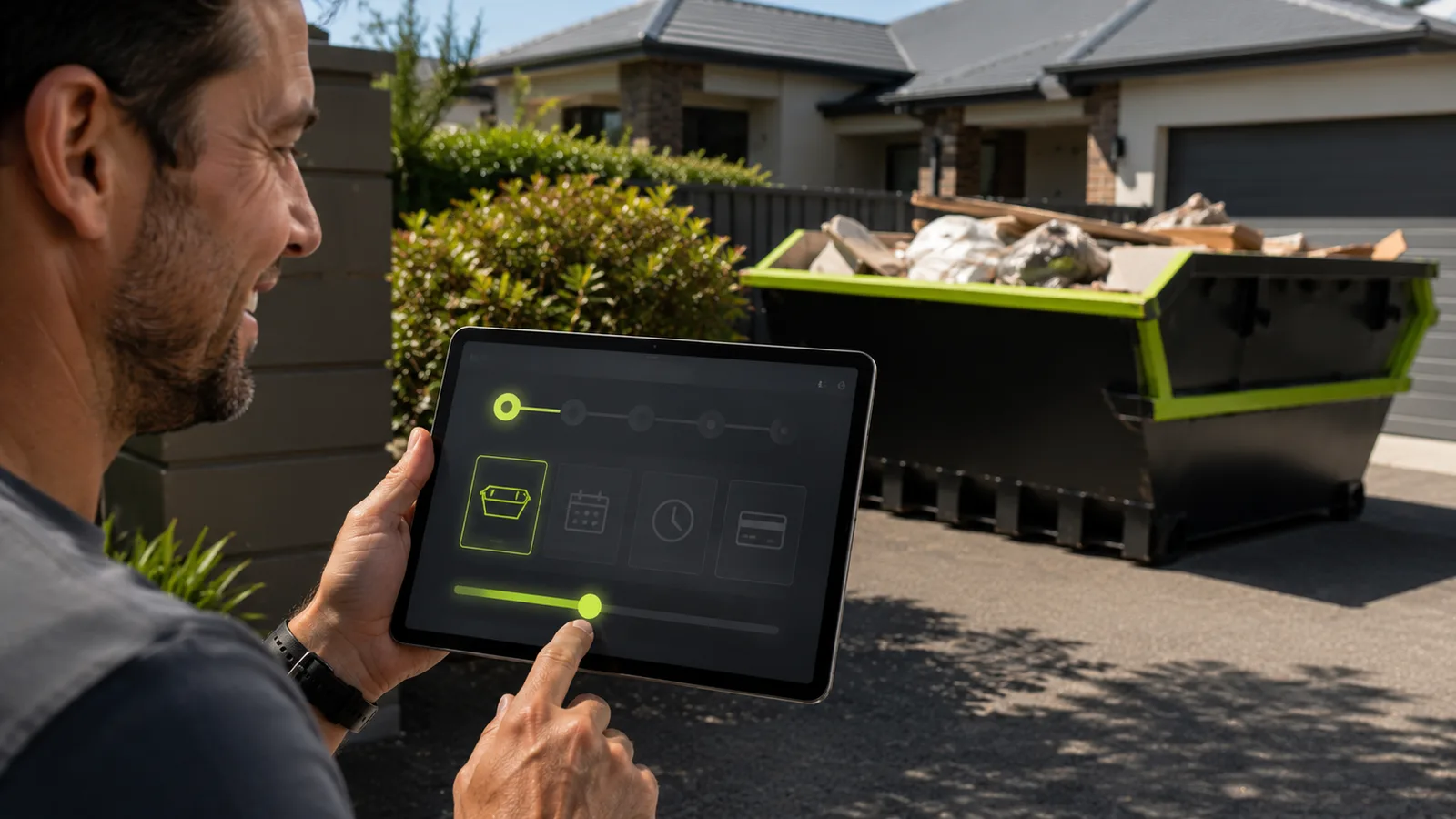
Ten years ago, customers booking a skip bin expected to call during business hours, wait on hold, and answer a list of questions while someone typed into a spreadsheet. In 2026, they expect something closer to booking a ride or ordering online, clear pricing signals, postcode validation, waste rules explained upfront, and confirmation in their inbox before the truck is scheduled.
That expectation gap is where skip hire operators lose jobs. Not because their service is worse, but because their website feels harder to use than the competitor's. This article breaks down what customers now expect from skip bin booking online, where traditional websites fall short, and what a modern hire experience looks like from first search to confirmed delivery.
How customer expectations shifted
Skip bin customers are not a separate species from every other online consumer. The same person who books a removalist online on Tuesday expects to hire a bin online on Saturday without a twenty-minute phone call. They compare your booking flow, consciously or not, to every smooth digital experience they use weekly.
That does not mean every customer will complete checkout without human contact. Complex jobs, commercial accounts, and unusual access still benefit from staff involvement. But the baseline shifted: online booking is the default path, and phone is the fallback when your website fails or feels untrustworthy.
Industry reality
Operators who treat online booking as "nice to have" still get phone orders, often from customers who tried the website first and gave up. You pay twice: lost margin on phone handling and lost jobs to competitors who made online easier.
The operational challenges of skip hire, zones, bin sizes, prohibited materials, council permits, placement constraints, are exactly why generic ecommerce and contact forms fail. Customers expect simplicity; your business requires structure. The gap is closed with purpose-built booking logic, not a prettier contact page.
For broader industry context on problems and opportunities, see the dedicated page for skip bin hire businesses and how technology supports deliveries on schedule instead of phone queues.
The first impression: mobile search to your site
Most skip bin searches start on a phone. Renovation debris piling up. A settlement deadline. A landscaping job running over. The customer searches "skip bin hire near me" or a suburb-specific query, scans the map pack, and taps a result.
Within seconds they decide:
- Does this company serve my area?
- Can I see bin sizes and rough pricing?
- Can I book now or do I have to call?
- Does this site look legitimate on mobile?
Slow mobile pages kill bookings before the wizard starts. Read why slow websites lose bookings and revenue and Core Web Vitals explained if performance is part of your gap. Local visibility matters too, local SEO for service businesses drives traffic that must convert on first visit.
Your homepage and hire landing page should route clearly to online booking, not bury "Book online" below paragraphs of generic copy. One prominent action: start booking, get a quote, or choose your bin.
Location and postcode validation
Nothing erodes trust faster than completing half a booking only to learn you do not service the address. Customers expect postcode or address validation upfront, before they invest time selecting bins and dates.
What customers expect
- Address autocomplete that works on mobile keyboards.
- Immediate feedback if they are outside your service area.
- Clear explanation of surcharges for fringe zones if applicable.
- No re-typing the same address at checkout.
What operators need behind the scenes
Validation must connect to real operational zones, not a static list buried in a PDF. Dynamic rules by postcode prevent unprofitable jobs, reduce redeliveries, and stop staff from manually cancelling orders after the fact.
The Skip Bin Booking system handles location as step one of a guided wizard: structured address capture, map-assisted entry, and zone logic that flows through to checkout without duplicate fields. That pattern, validate early, carry data forward, is non-negotiable for 2026 expectations.
Common failure
Free-text address fields with "we'll confirm service area after you pay" frustrate customers and create admin churn. Confirm serviceability before bin selection whenever possible.
Bin selection and transparent pricing
Customers want to compare bin sizes with capacity they understand, cubic metres, wheelie bin equivalents, or visual diagrams, and see pricing that matches their location and waste type. Hidden fees discovered at checkout feel like bait-and-switch, even when they are legitimate surcharges poorly communicated.
Pricing transparency
Best practice online hire flows show:
- Base hire price for each bin size in the customer's zone.
- Included hire period and daily overage rates if relevant.
- Add-ons with clear labels, extra days, mattresses, tyres, lockable lids.
- Running total updated as selections change.
Phone-only pricing worked when customers had fewer alternatives. Online, opacity drives abandonment. Competitors who show numbers win the job, even if your final price would have been similar.
Multiple bins and quantities
Commercial and renovation customers often need more than one bin. Quantity controls per bin type should feel as natural as ecommerce, without treating a skip hire as a generic "add to cart" for a T-shirt. The Skip Bin Booking product supports multiple bins and add-ons within a wizard designed for hire workflows, not retail carts alone.
| Customer question | What they expect online | What phone-only costs you |
|---|---|---|
| Which size do I need? | Visual size guide and examples by job type | Staff time explaining the same chart daily |
| What will it cost? | Zone-based price before checkout | Quotes delayed until callback |
| Can I get two bins? | Quantity selection in one booking | Separate orders, manual reconciliation |
| Any extra fees? | Line-item add-ons with descriptions | Disputes after delivery |
Waste types and compliance
Skip hire is regulated. Customers do not always know what belongs in a general waste bin versus green waste, clean fill, or construction debris. They still expect you to guide them clearly at booking, not surprise them with rejection or surcharges at pickup.
Waste guidance customers expect
- Plain-language categories with examples of allowed materials.
- Visible prohibited item lists, asbestos, liquids, batteries, tyres where relevant.
- Warnings before they confirm if their selection conflicts with stated waste.
- Price adjustments shown when waste type affects cost.
Compliance captured at booking protects margin and reduces confrontation on site. It also builds trust: customers feel you know your business, not that you trap them with fine print after payment.
Purpose-built hire software encodes waste rules into the flow, alerts, tooltips, and category-specific pricing, rather than relying on a PDF linked from the footer. That approach is central to the Skip Bin Booking wizard and reflected in the live implementation described in the skip bin booking system case study.
Scheduling, placement, and access details
Customers expect to choose delivery and pickup dates from a calendar, with blocked public holidays and realistic lead times visible immediately. Many also want time-of-day preferences (AM/PM) even if you operate in windows rather than exact slots.
Placement and access
Online booking should capture what phone staff always ask:
- Driveway vs nature strip vs on-road permit required.
- Clearance for truck access, overhanging branches, steep inclines, gates.
- Special instructions without a free-text novel.
- Contact on site if different from billing contact.
Structured placement steps reduce failed deliveries, one of the highest hidden costs in skip operations. When customers provide accurate detail during booking, drivers arrive prepared and your team spends less time on clarification calls.
Scheduling checklist for online hire
- Calendar respects blocked days and minimum notice rules
- Pickup date logic matches hire period automatically where possible
- AM/PM or window preferences captured and visible in admin orders
- Placement notes flow to dispatch without copy-paste
Checkout, payment, and confirmation
Customers expect secure payment or deposit collection online for many hire scenarios, especially domestic jobs where they will never meet your team before delivery. Even when you invoice commercial clients later, domestic flows increasingly mirror ecommerce: pay now, receive confirmation immediately.
Checkout expectations
- Booking summary visible before payment, bin, dates, address, waste type, add-ons, total.
- No re-entry of data already provided in the wizard.
- Guest checkout without forced account creation.
- Confirmation email with every detail needed for the customer and your dispatch team.
- Admin notification with structured order data, not a vague "new order" alert.
WooCommerce is a proven foundation for payments when configured for hire logic, but off-the-shelf carts alone rarely handle skip workflows. See WooCommerce for service bookings and WordPress vs custom booking systems for decision framing.
Broken emails and silent form failures destroy trust instantly. If customers pay but receive no confirmation, they call, doubling your workload and signalling unreliability. Pair hire flows with the practices in broken WordPress forms and monthly testing from website maintenance plans.
Where most operator websites fall short
After reviewing skip hire sites and building booking systems for operators, the same gaps repeat:
- PDF order forms or generic contact pages instead of structured hire flows.
- WooCommerce product pages that treat bins like shop items without zone or waste logic.
- No postcode validation until a human calls back.
- Waste rules buried in terms and conditions nobody reads.
- Phone number as the only conversion path on mobile landing pages.
- Slow, clunky mobile experience on pages that load heavy scripts and uncompressed images.
- Disconnected admin process, online orders arrive incomplete and staff re-key into spreadsheets.
These gaps align with the problems outlined on the skip bin hire industry page: phone overload, wrong bin sizes, postcode errors, missed add-ons, and compliance not captured at booking. Online expectations did not create those problems, they exposed them at scale.
Phone is not the enemy
Keep phone support for complex jobs. But default to online for standard domestic hires so staff focus on exceptions and high-value commercial relationships, not repeating the same intake questions forty times a week.
Building the right online booking system
Operators face a build-vs-buy decision: generic plugins, heavily customised WordPress, or fully custom software. Most regional and multi-truck operators land in the middle, WordPress for marketing and local SEO, plus a hire-specific booking layer integrated with WooCommerce for payments.
That middle path works when the booking layer understands hire semantics: zones, bins, waste, scheduling, placement, and admin exports, not just products and coupons. The Skip Bin Booking system was built for that middle path. The skip bin booking system case study documents outcomes from a real deployment: reduced phone intake, clearer orders, and a customer experience aligned with 2026 expectations.
Implementation priorities
- Fix mobile performance on hire entry pages before launching a wizard.
- Map operational zones and waste rules in software, not in staff heads.
- Run test bookings weekly through payment and email confirmation.
- Train dispatch on order fields produced by online flow, consistency matters.
- Promote online booking in GBP, ads, and invoice follow-ups, build habit.
If you are evaluating partners or platforms, use how to choose a WordPress developer and business technology audit questions to avoid vendors who deliver pretty pages without operational integration.
| Feature | 2026 customer expectation | Operator benefit |
|---|---|---|
| Postcode validation | Instant service area feedback | Fewer cancelled orders and wasted trips |
| Waste type wizard | Clear rules before booking | Less contamination and on-site disputes |
| Calendar scheduling | Choose delivery and pickup online | Less phone scheduling load |
| Structured checkout | Pay and confirm in one session | Faster cash collection on domestic jobs |
| Admin order detail | (Customer expects you to show up prepared) | Dispatch efficiency and fewer callbacks |
Explore the full system capability on Skip Bin Booking, industry-specific challenges on skip bin hire, and implementation proof on the case study. For strategic fit with your operation, book a technical strategy session or start with a business technology audit.
Conclusion
Skip bin customers in 2026 expect online hire to work like modern software, validated addresses, clear bins and pricing, waste rules explained, dates chosen on a calendar, payment and confirmation without a phone tag. Operators who meet those expectations win more domestic work with less admin overhead. Operators who hide behind "call for a quote" still get calls, often from people who already tried a competitor's smoother booking flow.
The complexity of skip hire is real, but it belongs inside structured booking logic, not on your customer's shoulders. Purpose-built systems on WordPress and WooCommerce bridge marketing, local SEO, payments, and dispatch-ready orders without forcing generic ecommerce to pretend it understands hire.
Start by auditing your current flow on mobile: search, land, book, pay, confirm. Note every friction point. Compare against the expectations in this guide and the resources on skip bin hire, Skip Bin Booking, and the booking system case study. Fix performance and validation first, they cost jobs before bin selection even begins.
Ready to align your website with how customers actually want to hire bins? Get in touch or explore related articles on WordPress vs custom booking systems and local SEO for service businesses.
Frequently asked questions
- What makes skip bin booking different from generic ecommerce?
- You need location validation, waste type rules, placement options, and often dynamic pricing by zone, not a simple add-to-cart.
Need help with this?
Let's review your setup
I help service businesses fix WordPress, bookings, security, and performance, with systems that support revenue, not just launches.
Related articles
 Bookings
WordPress vs Custom Booking Systems: How to Decide
Plugins are faster to launch; custom systems fit complex operations. Here is a honest framework for choosing without overbuilding or underinvesting.
Read article Bookings
WooCommerce for Service Bookings: What Works and What Doesn't
WooCommerce is built for products, but with the right architecture it powers deposits, add-ons, and complex service checkout flows.
Read article Moving
Moving Company Quotes: Phone-Only vs Online Booking Systems
Phone quotes made sense when moves were simpler. Today’s customers expect structured online intake, stairs, parking, van size, and all.
Read articleReady to talk?
Book a strategy session or send a message. I'll respond with a clear next step.